

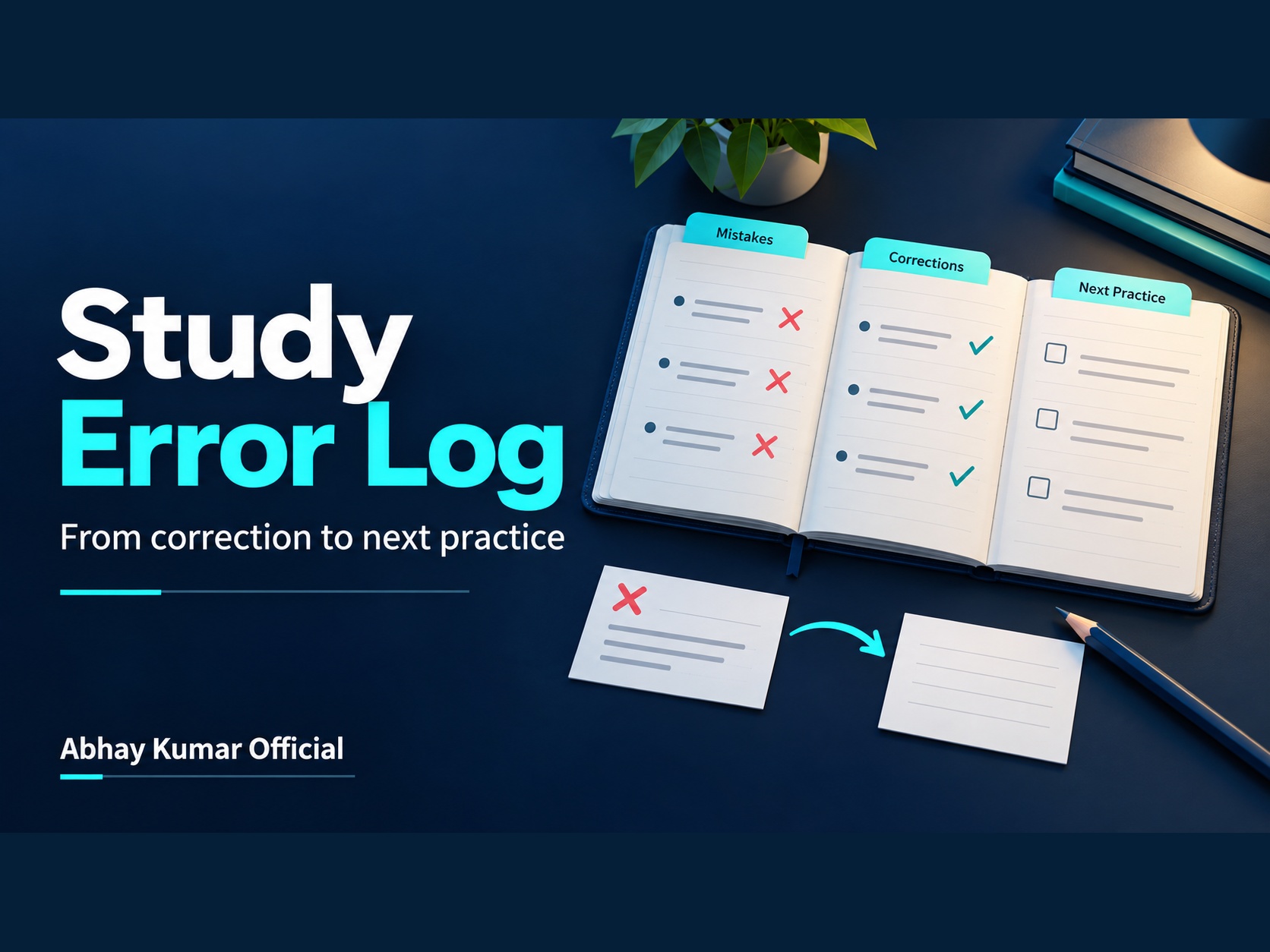
A marked answer tells you where marks were lost. A useful study error log goes one step further: it records what went wrong, what needs correcting, and what you will try without help next time. It is a working notebook for decisions, not a collection of disappointing results.
If you have ever read a solution, thought it looked obvious, and then repeated the same mistake, begin with a small change. Instead of copying the whole answer, write a short explanation of the gap between your attempt and the required task. Then give yourself a fresh question that tests that gap.
This guide offers a practical way to set up that record. The examples are illustrative, and the labels are tools for organising practice, not a diagnosis of how someone learns. Adapt them to your subject, syllabus and teacher’s instructions.
What belongs in a study error log?
A study error log is a selective record of mistakes worth revisiting. Each entry connects an actual attempt to a correction and a later check. A notebook, a sheet of paper or a simple spreadsheet can work. Choose the format you will open during your next practice session.
The important unit is one learning decision. An entire test paper is too broad to become a useful entry. At the other extreme, logging every crossed-out word can bury the patterns you need to see. Record errors that expose a missing idea, a fact you could not retrieve, an instruction you overlooked or a process you could not complete.
Include uncertain correct answers too. If you guessed, copied a method you could not explain or arrived at an answer by cancelling two errors, the result alone does not show what you can do independently. Mark it as uncertain rather than treating it as secure.
Start with a small set of fields
Your log needs enough detail to recover the task without becoming a second textbook. Begin with the fields below. You can put them on separate lines if a wide table is awkward to read on a phone.
- Question reference: the chapter, page, exercise or test item, with a short description.
- My attempt: the specific step, sentence or choice that needs attention.
- Error label: the best current description of the gap.
- Correction: the idea or procedure that should replace it.
- Next task: something you will attempt without the solution visible.
- Review result: what happened when you tried again, including remaining uncertainty.
A date is useful for locating the original attempt and the review, but it is not a score. Do not spend more time designing colour codes than examining the answer. If the notebook feels burdensome, shorten the entry before abandoning the practice.
Separate a recall gap from an understanding gap
A recall gap means you could not bring the needed information to mind during the task. You may be able to explain the idea accurately once prompted. For example, you understand what a scientific term describes but cannot produce its accepted name when a question asks for it.
An understanding gap is different. You may remember the words or formula but be unable to explain when they apply. For example, you can state a rule yet use it in a case where its conditions are not met. Copying the rule again does not address that uncertainty.
To investigate, close the solution and explain the idea in plain language. Give an example and, where appropriate, an example where it does not apply. If you cannot distinguish those cases, leave the label provisional and ask a teacher for clarification. A log should make uncertainty visible rather than conceal it behind a confident label.
The next tasks should differ. A recall entry might call for answering a short question from a blank page. An understanding entry might call for comparing two cases and explaining why the same method does or does not fit each one.
Keep instruction errors separate from knowledge errors
Sometimes the required knowledge is present, but the answer does not do what the question asks. A response may describe when it should compare, provide one reason when two are requested, or omit a unit that the question specifies.
Write the overlooked instruction precisely. An entry that says only “read carefully” gives you very little to practise. An entry that says “I listed two features but did not state a difference” points to a concrete repair.
For the next task, identify the command word and the required parts before writing the answer. Afterward, compare the finished response with that brief. Do not turn every instruction into a rigid ritual. Use the check that addresses the mistake you actually made.
If the wording itself is unclear, seek clarification instead of assuming a preferred interpretation. A marking guide or teacher can help distinguish an incomplete response from a reasonable answer to an ambiguous question.
Record procedure errors at the first wrong step
A procedure error occurs within a sequence: a sign changes, a value is substituted in the wrong place, an equation is rearranged incorrectly or a working step is omitted. The final answer may be wrong even when the overall method is suitable.
Trace your work until you find the first step that is no longer justified. Record that step rather than copying every line that follows. Later lines can all be wrong because of the same earlier slip.
Then write the reason the corrected step is valid. For a unit conversion, that might be the relationship between the units. For algebra, it might be the operation applied to both sides. A correction should tell you why the replacement is allowed.
Your next task can begin with a short exercise targeting that step, followed by a complete question. The short exercise checks the local repair; the complete question checks whether you can use it within a longer sequence.
A worked example: turning a vague note into a task
Imagine a student answering a mathematics question involving a discount and a final price. The student applies the discount to the wrong starting amount. The original log entry reads: “Percentage mistake. Practise more.”
A more useful entry would identify the reference amount. It might say: “I used the final price as the base even though the question defined the discount on the original price.” This describes the actual mismatch without labelling the student as careless.
The correction could be: “Name the quantity that represents the whole before calculating the percentage.” The next task could be to read a different discount problem, identify the base amount in words, and then solve it without referring to the worked answer.
At review, the student records what happened. If the base was identified correctly but the arithmetic failed, that is new information. Keep the first correction and add a separate procedure entry if needed. Do not replace a specific explanation with a broad judgement about being bad at percentages.
A worked example for a written subject
Consider a history answer that gives an accurate sequence of events but does not answer a question about causes. The student knows several relevant facts. The gap is in choosing and connecting evidence for the requested explanation.
The entry might record: “I retold events in order instead of explaining how each selected factor contributed.” The correction is not to memorise a longer version of the same narrative. It is to build an answer around the question being asked.
A suitable next task is to plan a response to another cause-based question using short points. Each point should connect a factor to its effect and include relevant supporting detail. The student can then compare the plan with class guidance before writing a full answer.
This example also shows why one label may not be enough at first. A weak explanation can involve both misunderstood content and an overlooked command word. Identify the main obstacle, test that repair and revise the label if the evidence changes.
Write corrections you can use without the original solution
A correction is useful when it tells your future self what to do differently. “Use the right formula” is not enough. Name the condition that selects the formula. “Add detail” is not enough either. Identify the missing evidence or connection.
Keep the wording in your own language while preserving technical accuracy. If the subject requires an exact definition, distinguish that definition from your explanation of it. Both may belong in the entry, but they do different jobs.
Avoid copying long solutions unless a particular sequence needs preserving. Link to the question reference or keep the marked paper nearby instead. The log should point you back to the relevant evidence while keeping the corrective decision easy to find.
When the correction is uncertain, mark it as a question. Bring the original prompt, your attempt and the precise point of confusion to a teacher. That is more useful than asking whether the whole chapter is understood.
Choose a retest that does more than repeat the answer
Repeating the identical item can help you check a corrected step, but remembering its final answer is not the same as handling a fresh task. Add a related question that changes a detail while keeping the same underlying demand.
For a definition, ask for an example that fits it. For a calculation, change the values or the unknown quantity. For an essay, change the evidence you must organise. For a language exercise, use the same rule in a different sentence.
Keep the difficulty appropriate to the gap. If you jump straight from a basic correction to a much harder problem, a new obstacle can hide whether the original repair worked. Make one clear check first, then try the skill in a more mixed setting.
Record whether you needed a hint. A completed answer with help can still be useful progress, but it should not look identical to an independent attempt. That distinction tells you what to try next.
Fit review into the practice you already do
The log is most useful when it leads into work, rather than sitting beside it. Before starting a practice session, choose an unresolved entry relevant to the material you are studying. Attempt its next task before opening the correction.
After checking, write a short result: completed independently, completed with a hint, still uncertain or a new error found. Use ordinary language. A complicated rating system can make a small notebook harder to maintain.
There is no need to impose one review timetable on every topic. Your next check depends on the difficulty, the kind of task, the material you have available and your course schedule. Set a realistic next review point rather than promising a routine you cannot maintain.
During a busy week, review a small selection that matches your current lessons. A short, focused session with a clear result is more informative than rereading a large backlog without attempting anything.
Use repeated errors to choose what needs help
Look across several entries for a repeated decision. Different questions may share the same obstacle: choosing a reference amount, interpreting a command word, identifying a condition or keeping units consistent.
Group those entries with a short label, but retain their question references. The examples show whether the pattern is genuinely repeated or whether several unrelated mistakes happen to share a broad topic name.
If the same repair keeps failing, do not simply write the correction in a brighter colour. Check whether your explanation is accurate, whether the next task actually tests the gap and whether you need guided help before another independent attempt.
Someone supporting your study can use these entries to see the work itself. Share only the relevant pages and avoid including classmates’ names, private messages or unnecessary personal information in a shared digital log.
Keep the log supportive and manageable
Describe an action, not an identity. “I omitted the second comparison” can be repaired. “I am careless” does not specify a task. Use language that makes the next step clear without turning the notebook into a record of self-criticism.
Do not compare entry counts between students. Someone logging more items may be working on different material, choosing a different level of detail or taking more challenging practice. The number of rows is not a measure of ability.
Archive entries when they no longer need active attention, while keeping them available if the issue returns. Your active list should help you choose practice, not make every session feel like catching up with every past mistake.
If you want support organising your study, you can explore the coaching and workshops described by Abhay Kumar Official. Use the contact page to ask what support is available and whether it fits your needs. A notebook is a practical study tool, not a promise of a particular result.
Frequently asked questions
Should I log every wrong answer?
No. Start with errors that reveal a useful gap or keep recurring. Several questions with the same cause can share one main entry with multiple references. Keep distinct causes separate when they need different repairs.
Can a correct answer go into the log?
Yes, if it was a guess or you cannot explain the reasoning. Label the uncertainty honestly and choose a fresh task that checks what you can do without help.
What if I cannot identify the error type?
Write what you observed and leave the label open. Take the question, your attempt and your uncertainty to a teacher. A provisional description is better than a confident but inaccurate explanation.
Is paper better than a spreadsheet?
Use whichever format makes the original question, correction and next task easy to find. Paper may suit handwritten working; a spreadsheet may make topic grouping easier. Neither format replaces actually attempting the retest.
When can I close an entry?
Move it out of the active list when your independent practice gives you a reasonable basis to stop prioritising it. Keep a brief result and reopen it if the same gap appears again. One familiar answer alone may not settle the issue.
What should I do first?
Choose one recent question. Write the first point where your attempt diverged from the task, explain the correction and set one fresh practice question. Build the log around that useful action before adding more fields.